Peptide Therapy for Weight Loss and Muscle in Menopause: What's Actually Working for Women Over 40
You have cleaned up your diet. You are consistent at the gym. You have tried cutting carbs, adding protein, tracking macros. The scale does not move. Your muscle keeps disappearing. Your energy gives out by early afternoon. And you have been told, more than once, that your labs are normal.
This is not a discipline problem. There is a biological explanation for what you are experiencing, and it has everything to do with what is happening hormonally in perimenopause and menopause. The approach that worked in your 30s is not built for the body you are in now.
Why Weight Changes in Midlife Are Not About Eating Less
The standard weight loss framework, eat less and move more, was built around male physiology. Women's metabolism is cyclical and hormonally layered in ways that model simply does not account for. Estrogen, progesterone, cortisol, and insulin interact with each other constantly, and each one influences how the body stores fat, builds muscle, regulates blood sugar, and responds to food.
When estrogen drops through perimenopause and menopause, several things shift at once. Metabolism slows as the hormonal signals that drive efficient energy use weaken. Insulin sensitivity decreases, making it harder to regulate blood sugar and easier to accumulate fat in the abdomen. Cortisol takes longer to clear, which feeds inflammation and visceral fat storage. And muscle mass, already declining at roughly 8% per decade after age 30, accelerates that loss around menopause.
Muscle is the body's primary metabolic engine. Less of it means slower metabolism, more hormonal instability, higher baseline inflammation, and greater insulin resistance. Cutting calories in this context often makes things worse. You lose muscle alongside fat, slow the metabolism further, and end up exactly where you started.
What Peptides Actually Do for Metabolism and Body Composition
Peptide therapy works at the biological level rather than the symptomatic one. These are the protocols we use most often for metabolic and body composition support in women over 40.
Tirzepatide (GLP-1/GIP Receptor Agonist)
Tirzepatide activates both the GLP-1 and GIP pathways, which together regulate blood sugar, appetite, and fat metabolism. For women dealing with insulin resistance or midsection weight gain that does not respond to diet and exercise, it is one of the most clinically supported tools available. In a precision women's health setting, we often use it at lower doses focused on metabolic stabilization rather than aggressive weight loss. Research published in Biochemical Pharmacology also found that GLP-1 and estrogen interact to regulate lipid metabolism, which is part of why combining Tirzepatide with BHRT tends to produce better results than either alone.
Sermorelin
Sermorelin stimulates the pituitary gland to produce growth hormone naturally. It does not introduce synthetic GH from outside. Growth hormone supports lean muscle retention, fat metabolism, cellular repair, and sleep quality, all of which decline with age. Most patients run 12-week cycles, and the first thing many women notice is better sleep, followed by gradual improvements in energy and body composition over the following weeks.
BPC-157
BPC-157 is studied primarily for its anti-inflammatory properties at the gut and tissue level. Chronic low-grade inflammation is one of the most consistent drivers of metabolic dysfunction in midlife women. It impairs insulin signaling, disrupts hormonal receptor function, and makes everything else harder to fix. BPC-157 addresses inflammation at the cellular level, which creates a better environment for hormonal therapies and other peptides to work.
NAD+
NAD+ is essential for mitochondrial function, meaning it is directly involved in how your cells convert food into usable energy. NAD+ drops significantly with age, and low levels show up as fatigue, mental fog, and a metabolism that feels like it is running on half power. Supplementing NAD+ supports cellular energy production, improves exercise recovery, and makes the other interventions more effective.
The Foundation That Makes Peptides Work
Peptides amplify what is already in place. Without the right foundation, results are limited.
Resistance training is non-negotiable. Muscle is the body's largest endocrine organ. It secretes hormones, regulates metabolism, and controls blood sugar. The goal is not aesthetics. It is preserving the lean mass that keeps your metabolism functional as you age. Three to five sessions per week with progressive resistance is the evidence-supported baseline.
Protein needs go up, not down. Perimenopause is not the time to reduce protein intake. The target is 30 to 40 grams per meal, ideally front-loaded in the morning when cortisol is naturally higher and blood sugar is most sensitive. This gives the body what it needs to maintain muscle, stabilize hormones, and keep energy steady throughout the day.
Eating in alignment with your circadian rhythm matters. Women's metabolisms are not running on a 24-hour flat line. They are layered with hormonal rhythms. Protein-heavy mornings, moderate midday meals, lighter evenings, and a 12 to 14-hour overnight fasting window improve insulin sensitivity, help cortisol clear, and support the overnight action of peptides like Sermorelin and BPC-157.
What BHRT Adds to the Picture
BHRT does not just manage symptoms. It changes the metabolic environment. Estrogen is directly involved in insulin sensitivity, fat distribution, lean muscle preservation, and mitochondrial efficiency. When estrogen is restored appropriately, the body's ability to respond to exercise, nutrition, and peptide therapy improves significantly.
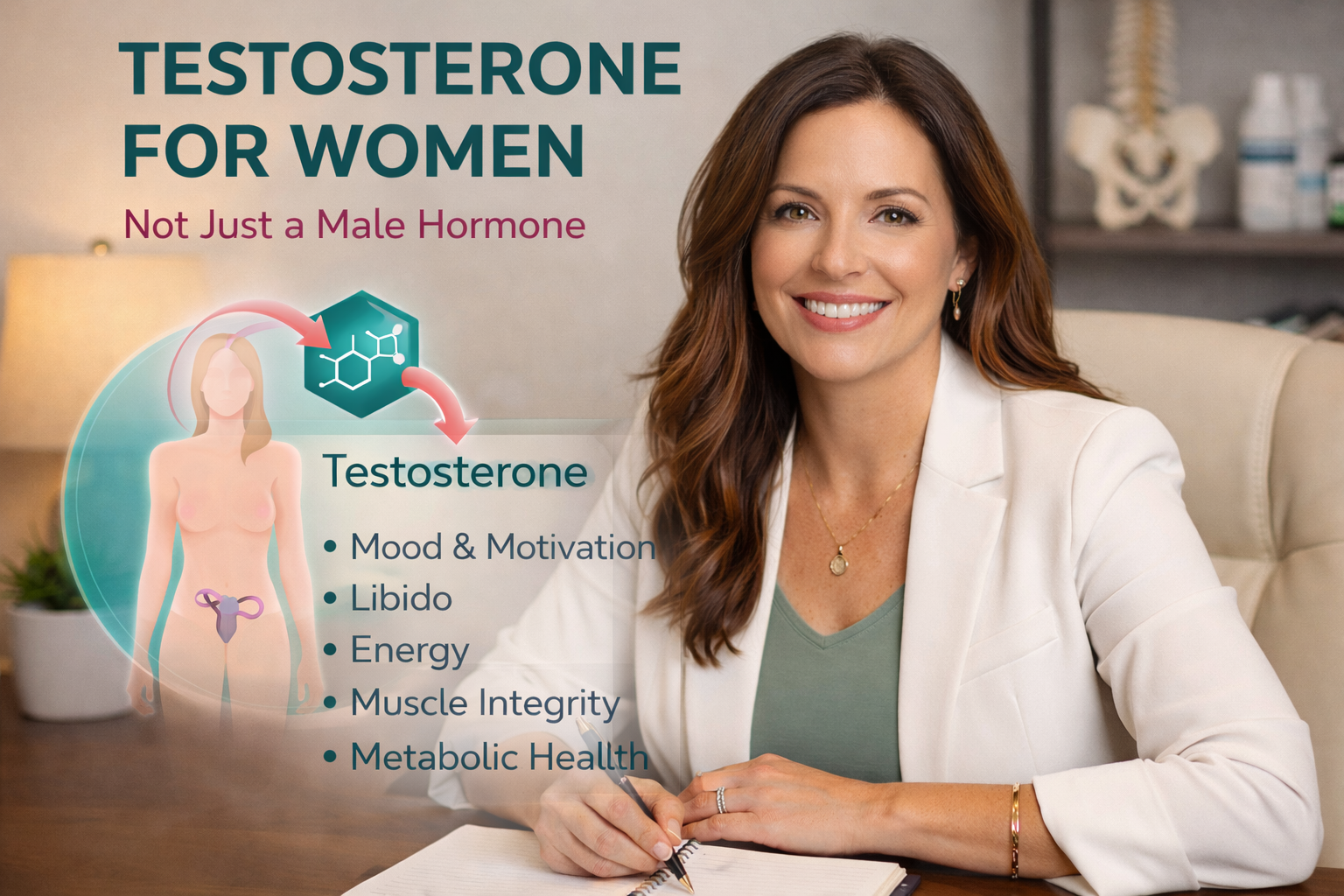
Testosterone is often overlooked in women's hormone protocols, but it matters considerably for body composition. Low testosterone in women contributes to muscle loss, reduced metabolic rate, low drive, and cognitive fatigue. When testosterone is brought back to an appropriate range, women typically see meaningful improvements in strength, body composition, and energy.
Frequently Asked Questions
What are the best peptides for weight loss in women over 40?
Tirzepatide, Sermorelin, BPC-157, and NAD+ are the peptides we use most often for metabolic support and body composition in midlife women. The right combination depends on your labs, your symptoms, and your goals. There is not a universal protocol because the underlying causes vary.
Does BHRT help with weight loss during menopause?
BHRT improves the hormonal environment that makes weight management so difficult in menopause, particularly insulin sensitivity, cortisol regulation, and lean muscle retention. It is not a weight loss medication, but restoring hormonal balance consistently makes body composition changes more achievable.
Is Tirzepatide the same as Ozempic?
No. Tirzepatide (Mounjaro, Zepbound) works on both GLP-1 and GIP pathways. Semaglutide (Ozempic, Wegovy) works only on GLP-1. Clinical trials show Tirzepatide tends to produce stronger metabolic results. Both have a role in women's health depending on the clinical picture and dosing needs.
Will I lose muscle on peptide therapy?
Sermorelin and NAD+ specifically support lean muscle retention and growth hormone production. When combined with adequate protein and resistance training, peptide protocols are designed to protect muscle, not deplete it.
Can peptide therapy help with menopause belly fat?
Yes. Visceral fat accumulation in menopausal women is driven by multiple converging factors including insulin resistance, cortisol dysregulation, estrogen decline, and chronic inflammation. A protocol that addresses all of those simultaneously tends to move the needle in ways that single-track approaches do not.
Do you offer peptide therapy in Dallas and via telehealth?
Yes. Optimize by JaeNix sees patients in person in Dallas near the Galleria and via telehealth in TX, CO, FL, IA, VT, VA, WA, and CT. Reach out to schedule and we will walk you through the right starting point.
Start With a Complete Clinical Picture
Hormone and peptide optimization at Optimize by JaeNix begins with labs and an individualized evaluation. In-person in Dallas or telehealth across TX, CO, FL, IA, VT, VA, WA, and CT.
Book a Consultation